
- Usage
- Popular coloring
Popular coloring
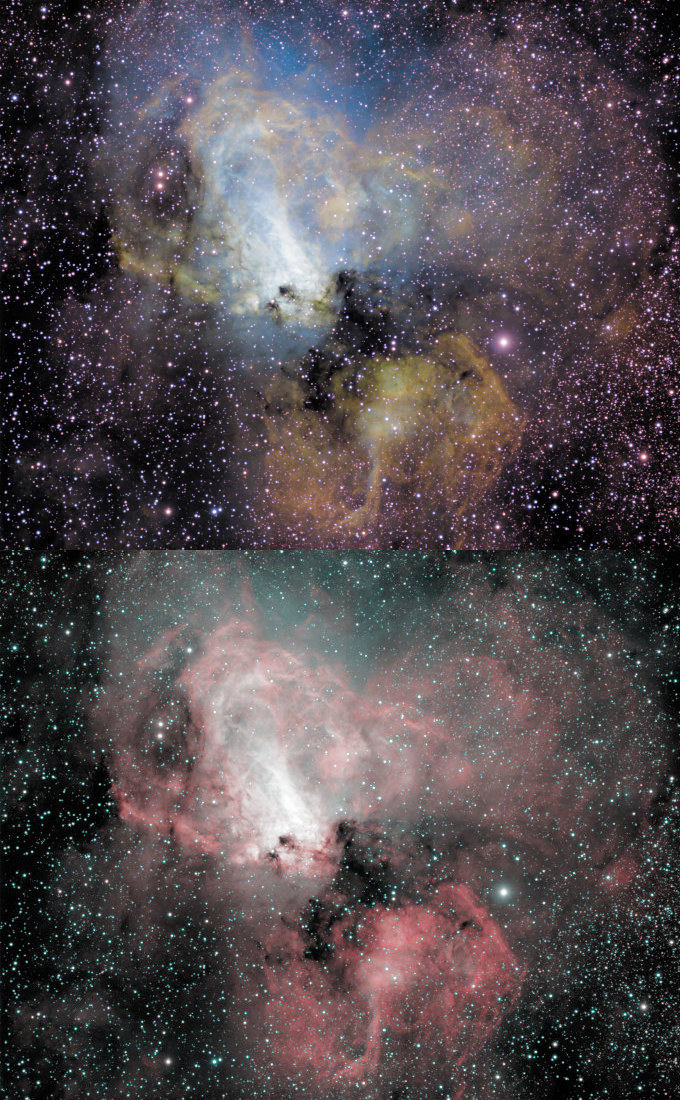
Popular narrowband composite colouring
Hubble / HST / SHO
The Hubble Space Telescope palette (also known as 'HST' or 'SHO' palette) is a popular palette for color renditions of the S-II, Hydrogen-alpha and O-III emission bands. This palette is achieved by loading S-II, Hydrogen-alpha and O-III ("SHO") as red, green and blue respectively. A special "Hubble" preset in the Color module provides a shortcut to color rendition settings that mimic the results from the more limited image processing tools from the 1990s.
H-alpha + O-III bi-color
A popular bi-color rendition of H-alpha and O-III is to import H-alpha as red and O-III as green as well as blue. A synthetic luminance frame is then created that only gives red and blue (or green instead of blue, but not both!) a weighting according to the two datasets' exposure lengths. The resulting color rendition tends to be close to these bands' manifestation in the visual spectrum with H-alpha a deep red and O-III appearing as a teal green.
You may also be interested in...
- Usage (under Compose)
"L, RGB" simply uses the loaded luminance dataset for luminance and uses red, green and blue for the colour information.
- Using masks from startools.log (under Usage)
StarTools stores the masks you used in your workflow in the StarTools.log file itself.
- Matrix correction and on-the-fly channel remapping (under Usage)
The matrix or channel blend/mapping is selected using the 'Matrix' parameter.
- Color: Advanced Color Correction and Manipulation (under Features & Documentation)
The Color module fully capitalises on the signal processing engine's unique ability to process chrominance and detail separately, yet simulatenously.
- Usage (under Filter)
In this mode, the user must click on the coloring that is to be preserved while the H-alpha is boosted.